


The Price of Patient Capital
The Price of Patient Capital
Why Japan's homebuilding bet on America is a cost-of-capital story, and why the same cash flows can support different prices.
I recently spoke with a finance executive who had spent years underwriting land acquisitions for a U.S. homebuilder and was there when the company came under Japanese ownership. Before the acquisition, he said, proposed land investments generally needed to clear return hurdles of 15% to 18%. Under the new owner, the hurdle moved closer to 9%.
That is one executive's experience, not evidence of a universal Japanese underwriting standard. But it illustrates the financial mechanism behind a much broader M&A pattern.
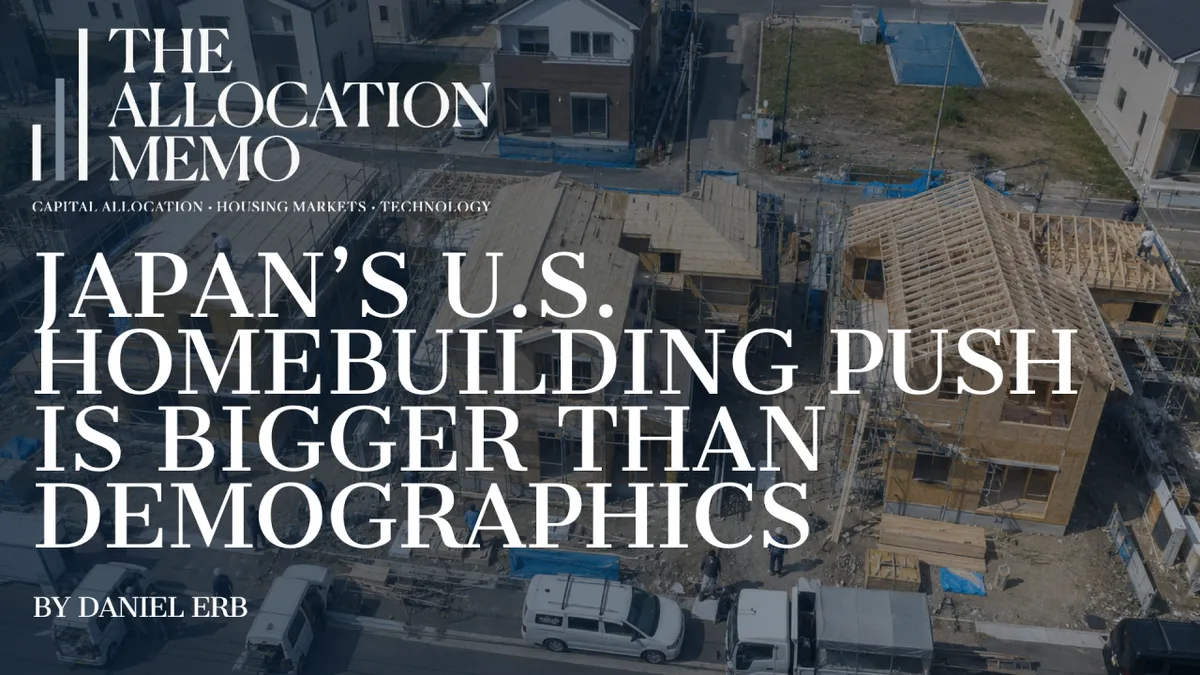
Japanese-owned builders accounted for roughly 0.2% of U.S. single-family closings in 2015 and 4.7% in 2025. After the announced 2026 transactions, the share was expected to exceed 5.5%.
Demographics explain why the capital is leaving Japan. Operating platforms explain why it is entering through homebuilders. A lower required return helps explain why these buyers can keep deploying and, in some cases, pay prices other owners will not.
Capital follows household formation
Japan's demographic pressure is already measurable. Its population was 126.15 million in 2020. Under the government's central projection, it falls to approximately 87 million by 2070, while the share aged 65 and older rises from 28.6% to 38.7% (National Institute of Population and Social Security Research).
The housing market is moving in the same direction. Japan recorded 740,667 housing starts in 2025, down 6.5% from 2024 and the third consecutive annual decline.
For a Japanese homebuilder, this creates a capital-allocation problem. The company may have strong construction systems, supplier relationships, and financing capacity. Those capabilities are still attached to a domestic market producing fewer future customers.
A business cannot manufacture household formation, but it can move toward it.
The United States is not an endless-growth market. The Census Bureau's middle projection has the U.S. population peaking around 2080 and then edging lower. The relevant point is comparative: Japan faces a much steeper near-term contraction, while the United States offers several more decades of growth, regional migration, and a far larger base of households.
Why buy builders instead of buildings?
If the thesis were only that U.S. demographics look better than Japan's, these companies could buy apartments, warehouses, land, or listed real estate. Many do. Homebuilders are different because Japanese buyers are not passive pools of capital. They are housing companies.
A local land engine
A national population forecast does not identify which parcel will receive entitlements, which school district will attract buyers, or which subcontractors can deliver on budget. Acquiring a regional builder buys the local relationships, land pipeline, trade network, and management team needed to turn a macro thesis into actual closings.
A platform for operating capabilities
The buyers also have capabilities they believe can travel. Daiwa House has described applying industrialized construction, off-site wall-panel production, joint procurement, and supply-chain coordination across its U.S. builders. Sekisui House is unifying design, construction and material standards, procurement, and sales coordination across its U.S. platform.
The results remain mixed. Sekisui's U.S. platform delivered 11,712 homes in FY2025, down from 14,860 in FY2024. Its U.S. homebuilding operation posted a loss, while its U.S. master-planned-community business remained profitable. Strategic fit does not remove housing-cycle or execution risk.
A fragmented market
U.S. builders closed 679,083 new single-family homes in 2025. The top ten represented 43.6% of those closings, leaving more than half of the for-sale market outside the largest national platforms. That fragmentation creates room to acquire regional operators without rebuilding every local capability from scratch.
Required return is the real pricing variable
This is where terminology matters. An internal land hurdle, a target return on equity, and a company's weighted average cost of capital are related, but they are not interchangeable. The executive's 9% figure was a project hurdle. It was not a disclosed corporate WACC.
There is broader evidence that Japanese buyers think differently about required return and duration. Margaret Whelan, an investment banker active in builder M&A, told CNBC that Japanese groups often target about a 5% return on equity, compared with roughly 10% for U.S. public builders. That is an industry estimate, not reported guidance, and it should not be treated as directly comparable to an internal land hurdle. It still supports the direction of the argument: some Japanese owners may accept a lower return for longer.
The public record does not show that the entire advantage comes from cheap dollar debt. Sekisui's October 2024 U.S. dollar bonds carried 4.70% and 5.10% coupons. Sumitomo initially funded the Tri Pointe acquisition with a yen-denominated bridge facility that it planned to refinance. Financing structure matters, but public disclosures do not isolate how much of the advantage comes from debt cost, equity return requirements, or strategic tolerance for a longer payback.
The valuation effect is straightforward. Consider an illustrative asset producing $100 a year for ten years. Discounted at 9%, those cash flows are worth about $642 today. At 15%, they are worth about $502. The lower-return buyer can value the same cash flows roughly 28% higher without changing a single operating assumption.
That can expand the land pipeline a company is willing to approve, support a larger inventory position through a slow cycle, and raise the price it will pay for an operating platform. It can also transfer much of the benefit to the seller.
Sumitomo's announced acquisition of Tri Pointe was valued at approximately $4.5 billion including debt, or $4.1 billion on an equity-value basis, and represented a 29% premium to the prior closing price. The deal added more than 150 active communities and accelerated Sumitomo toward its target of 23,000 annual U.S. deliveries by 2030.
A lower required return may explain why a buyer can pay more. It does not prove the buyer created value by doing so.
The Capital Migration Test
When foreign capital moves aggressively into a U.S. sector, I would test the thesis through five questions.
1. What is pushing the capital out?
Distinguish a temporary slowdown from a structural decline in domestic demand. Japan's population trajectory makes the pressure structural.
2. What is pulling the capital in?
Separate durable household and employment growth from recent price appreciation. In housing, the national direction may be favorable while returns remain metro- and subdivision-specific.
3. What capability travels with the capital?
Identify procurement scale, construction systems, operating processes, financing capacity, or industry expertise that can improve the acquired platform.
4. What must still be acquired locally?
Land sourcing, entitlements, customer preferences, and trade relationships remain local. Parent-company resources do not replace local execution.
5. Has the advantage already been paid for?
Examine the acquisition premium, leverage, realized margins, and evidence of operating gains. Scale is evidence of conviction, not proof of return.
What this means for allocators
Japanese ownership is a meaningful signal about the long-term strategic value of U.S. homebuilding. It is not an endorsement of every builder, land investment, or residential fund.
National demographic growth cannot rescue an oversupplied subdivision, an unaffordable price point, or a land basis that assumes perfect execution. Any investment still has to clear three separate tests:
Is the macro direction right?
Is this the right operating platform and local market?
Does the entry price leave enough return for the risk?
Japan's housing companies have a coherent answer to the first question. Their acquisitions give them the local infrastructure to address the second. The third will determine whether the strategy creates value.
The larger lesson extends beyond homebuilding. Patient capital changes the clearing price. It does not repeal underwriting.
A lower required return may explain why a buyer can pay more. It does not explain why you should.

COMPANY
FOLLOW US
