



How UK Housing Can Compete With US Multifamily
Daniel Erb | Founder & CEO, EM Capital | November 12, 2026
The investment case begins with the cash a US allocator keeps after taxes and costs.
6.0%
Pre-tax IRR in both countries, same property economics
4.4% vs 4.1%
After-tax IRR, US building versus direct UK
3.6% vs 2.7%
After cost budgets and modeled taxes, including SDLT
My recent presentation at the US–UK Housing and Regeneration Mission in New York explored how US investors should assess housing opportunities across the Atlantic. For an allocator, that starts with a familiar decision. Does the UK opportunity offer enough return for its risk compared with US multifamily?
In our worked comparison, identical property economics produce a higher after-tax return for the US investment. UK housing can still earn a place in a broader portfolio where better pricing, stronger cash flow or diversification justify the allocation. Sponsors need to make that case in after-tax dollars and show what the UK investment adds to the portfolio.
Start with the same investment
Assume comparable investment risk between Class A core multifamily in the two countries. Put $1 million into each property without debt, at a 4% initial net operating income (NOI) yield after operating expenses and owner-paid property taxes. Initially, NOI equals cash available before income taxes. NOI and distributions grow 2% annually for ten years. We sell at the end of year ten using year-eleven NOI divided by a 4% exit yield, and receive the year-ten distribution separately. Sterling stays constant; the UK property is in England.
The 2% growth follows our assumed inflation rate. For a lease linked to inflation, check the index, any caps or floors and reset timing; rising costs can still prevent NOI and distributions from keeping pace.
Our reference investor is a US citizen resident in the US, filing singly, with $2 million of other US taxable ordinary income and no other UK income. We allocate 80% of price to the building and use annualized depreciation, 37% US ordinary tax, 20% capital-gains tax, 25% on depreciation-related real estate gain and 3.8% net investment income tax (NIIT). State tax is zero. Institutions and tax-exempt investors require a different comparison.
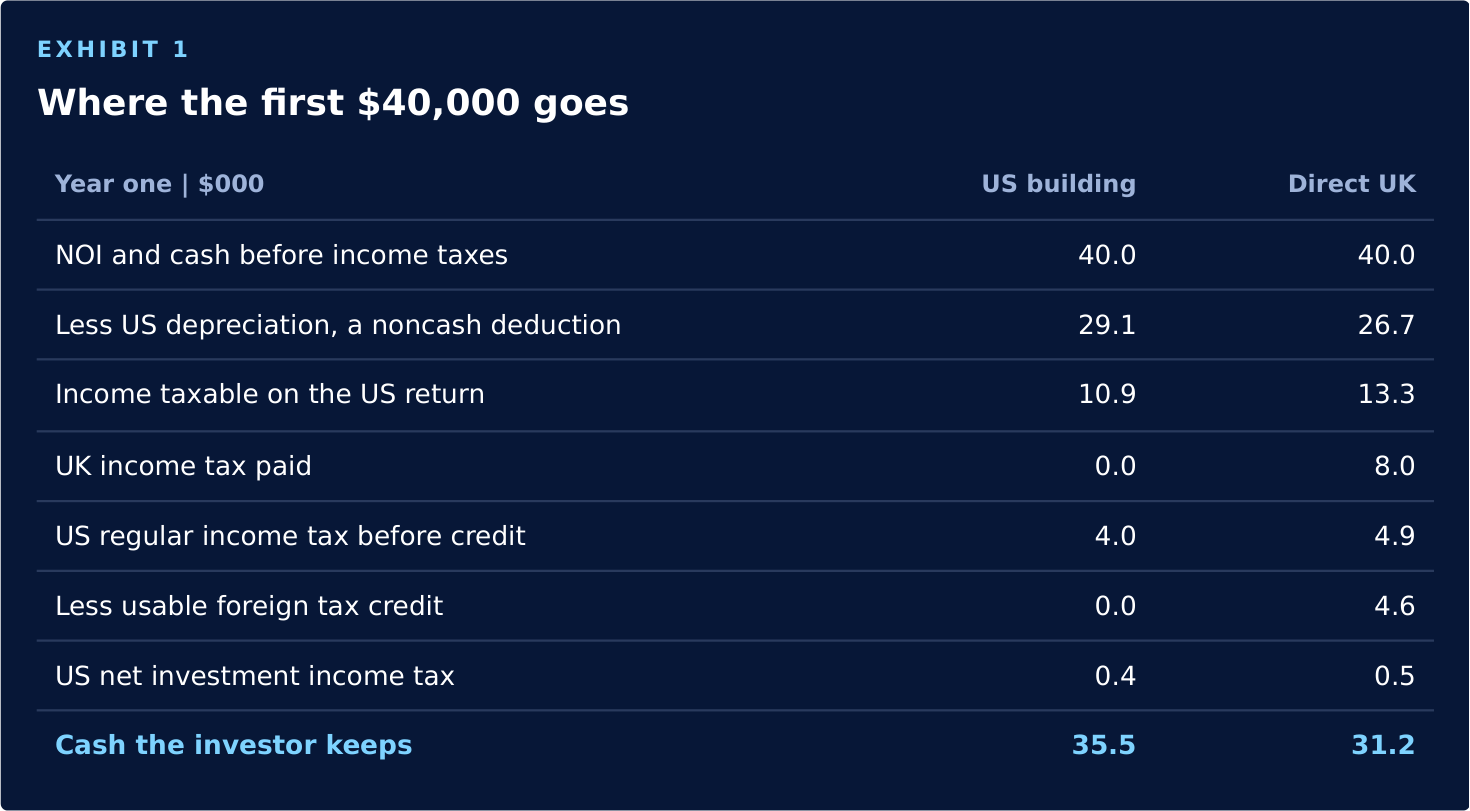
Source: EM Capital model. UK tax is 20% in the first period, mapped to 2026/27; no UK personal allowance is assumed. Future periods use enacted 2027/28 rates, held constant. Taxes and credits are settled at year-end. Figures are rounded.
In England, tenants generally pay council tax on occupied homes; owners can bear it during vacancies and designated cases. Any owner-paid charge is already included before NOI.
Sources Property-charge framework
US depreciation reduces taxable income without using cash. An $800,000 building allocation produces an annual deduction of $29,091 over 27.5 years for the US property, or $26,667 over 30 years for the UK property. The UK does not allow that general building-depreciation deduction against its rental profits.
Sources IRS depreciation rules · HMRC expense rules
The IRS taxes both properties’ income. For the UK building, the investor also pays $8,000 of UK tax. The US–UK treaty provides a route to double-tax relief, but the credit is limited: about $4,642 is usable in year one. After remaining US tax and NIIT, the investor keeps $31,202, compared with $35,549 from the US building.
Sources US–UK treaty · Foreign tax credit calculation
THE INSIGHT
Sponsors need to make that case in after-tax dollars and show what the UK investment adds to the portfolio.
A tax shield has to survive the sale
Year-eleven NOI reaches $48,760. Dividing by the 4% exit yield gives a sale price of about $1.219 million. Add the ten distributions of about $438,000 and the investor receives $1.657 million, including the original capital. The resulting $657,000 profit produces a 6.0% pre-tax IRR in both countries.
Depreciation also reduces tax basis, the cost remaining for calculating gain. The US basis falls to about $709,000, making taxable gain roughly $510,000. Of that, $291,000 is depreciation-related gain taxed at 25%, and $219,000 is appreciation taxed at 20%. Regular federal tax is about $116,500; NIIT adds $19,400. The investor keeps about $1.083 million from the sale, plus the separate year-ten distribution.
For the UK sale, the US basis is about $733,000. UK capital-gains tax of $51,600 is credited against about $110,500 of regular US sale tax; NIIT adds $18,500. The investor keeps roughly $1.090 million, slightly more at exit but less in annual cash. The UK calculation uses sterling appreciation, 18% / 24% rates and an unused £3,000 annual allowance.
Now give each investment the same $200,000 pool of existing US passive rental losses. We assume the losses are usable under the basis, at-risk and passive-loss rules and would otherwise remain unused during the hold. Both investments fully use the pool by the cash sale.
Eligible US passive losses can offset passive UK rental income on the US return. The rules do not generally exclude rental income because the building is abroad. UK tax still applies, and the US loss deduction and foreign tax credit require separate calculations. Exhibit 2 applies the same investor tax attributes to both investments.
Sources Passive-loss rules · Income and deduction sourcing
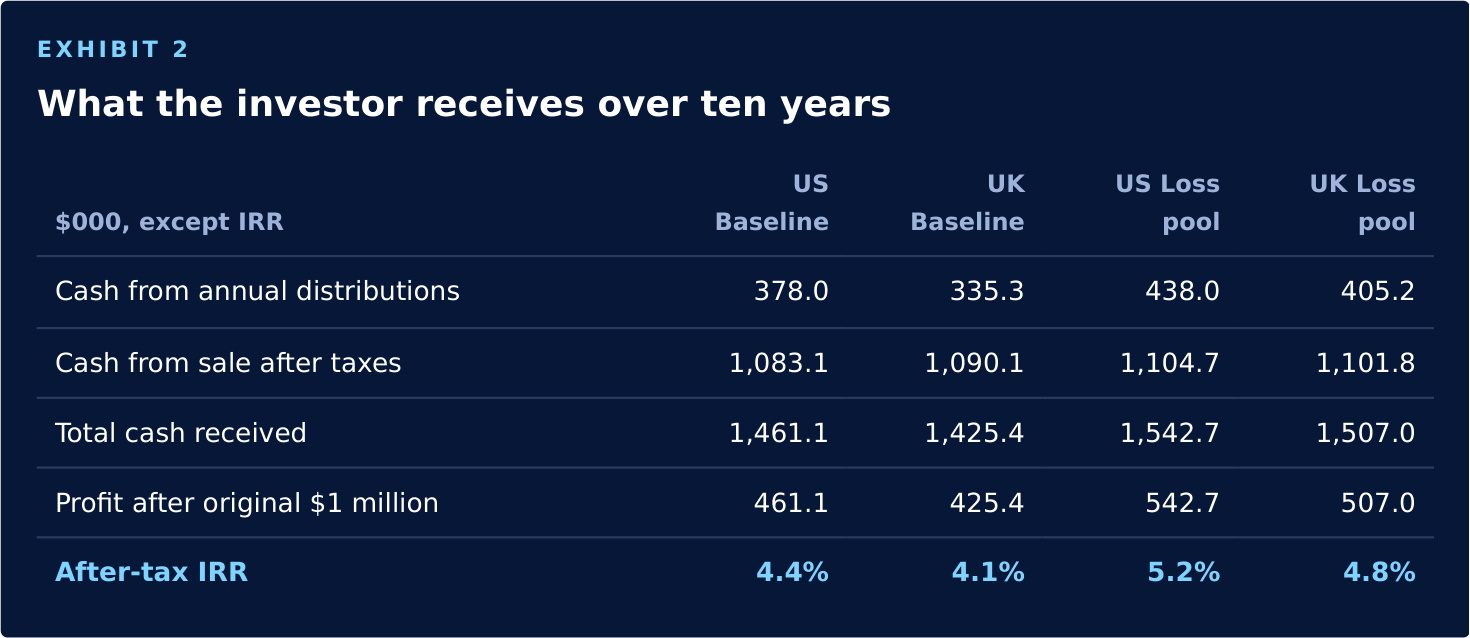
Source: EM Capital annual cash-flow model. All four cases sell for $1.219 million before tax. Baseline includes building depreciation but no outside losses. Loss cases use the same $200,000, including remaining usable losses at sale. Net here means after modeled federal and UK taxes, including credits and NIIT; the additional costs below remain excluded.
Those losses have alternative uses elsewhere in the portfolio. Corporate fund dividends generally cannot absorb them as rental income can. Cost segregation can accelerate deductions on eligible US components, but an entire apartment building does not qualify for bonus depreciation, and foreign-use property generally cannot receive it. Borrowing itself is not a rental-income deduction.
Sources IRS depreciation and bonus rules
What the JPUT changes
Based on my research, a Jersey Property Unit Trust (JPUT) is useful here as a way to organize ownership without adding a corporate tax layer. We assume a deed that passes rental income through to unitholders, a valid UK election for gains transparency and eligible partnership classification for US tax. The UK treatment does not determine the US classification.
Under those assumptions, the UK return remains 4.1% without outside losses and 4.8% with them, before additional JPUT costs. The structure preserves the direct-ownership tax result. A company or differently classified fund can add corporate taxes, shareholder taxes and reporting requirements. Sponsors should establish the classifications and elections before quoting the investor’s return.
Sources Carey Olsen’s JPUT guide · HMRC income treatment · HMRC gains election · US classification rules
Section 1031 concerns reinvestment. A qualifying US property exchange can defer US gain, but US property cannot be exchanged tax-deferred for foreign property. Direct foreign property can potentially be exchanged for other foreign property. Partnership-classified JPUT units do not qualify, although the vehicle can potentially exchange eligible property it owns.
Sources Section 1031 · IRS eligibility rules
A US-tax exchange does not automatically defer UK tax. Our UK example could still leave about $52,000 of UK capital-gains tax to fund. Reinvested proceeds are not cash returned to the investor, so Exhibit 2 uses cash sales. An exchange comparison must show the replacement asset, carried tax basis and deferred liability.
Sources UK rollover requirements
Move from the tax illustration to an investable offer
The initial illustration spent the whole $1 million on property. Now make $1 million the total opening cash commitment. Budget purchase expenses at 1% of price and sale expenses at 2%. Annual oversight is 0.25% of purchase price; structural capital spending starts at 0.5% and grows 2%. Property administration is $1,000 a year in the US or $3,000 in the UK. These are budgets, not fee quotes.
For England, assume six or more qualifying dwellings bought in one transaction, using nonresidential Stamp Duty Land Tax (“SDLT”) rates. At $1.30 per pound, about $34,164 goes to SDLT. The purchase price must therefore fit inside this equation: property price + 1% purchase expenses + applicable SDLT = $1 million.
Sources SDLT bands and six-dwelling rule
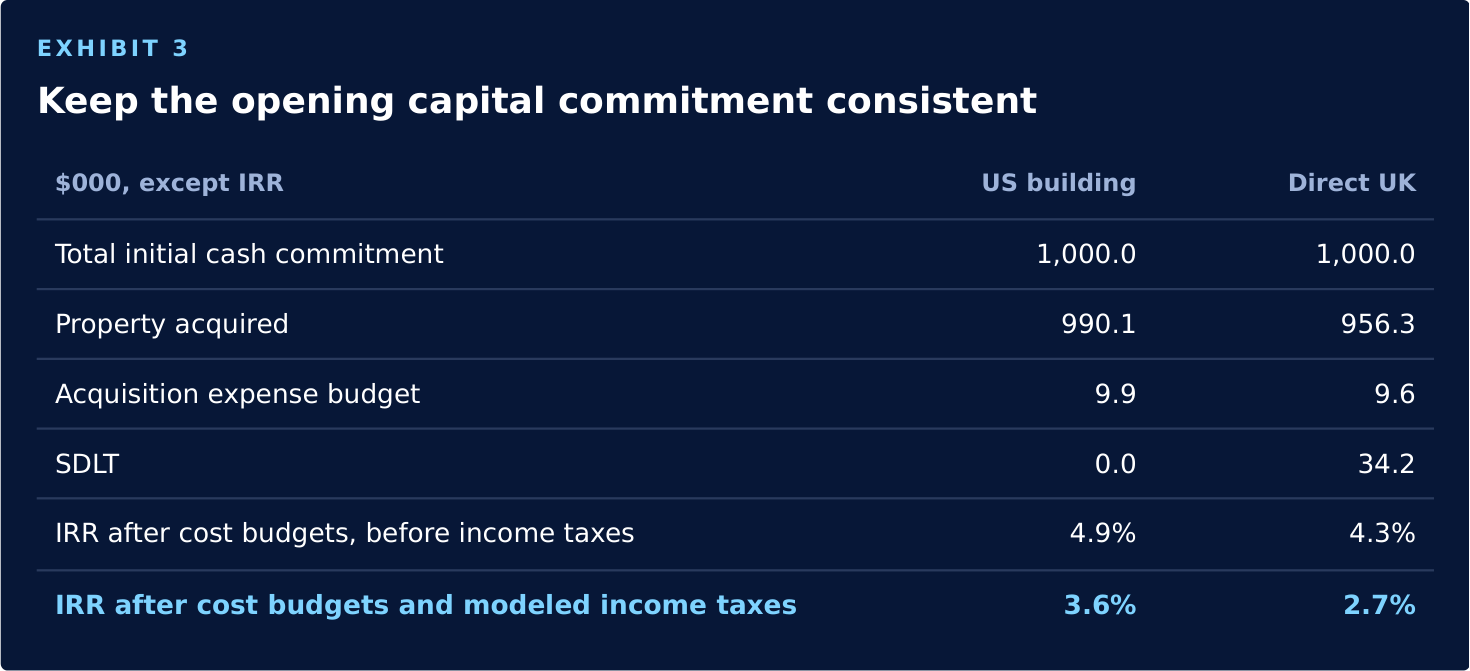
Source: EM Capital model. No outside loss pool in this cost comparison. The acquisition allowance includes assumed US transfer costs; UK SDLT is additional. No promote, unquoted JPUT establishment/trustee fees, personal adviser fees, hedging or state tax is included. These are returns after the specified budgets, not universally fully net returns.
What would strengthen the UK case
Government support can improve the economics of eligible housing delivery and regeneration. Homes England and the National Housing Bank offer grants, loans, equity and guarantees. A grant can close a cost gap; financing or a guarantee can change the capital required and risk borne by private investors. A UK sponsor needs to illustrate how this benefit reaches the investor.
Sources Investment prospectus
This is not uniformly zero-return capital. The prospectus seeks portfolio-level financial returns on debt, equity and guarantees; published smaller-housebuilder loans carry interest margins of 3% to 7%. The US also supports housing through FHA multifamily mortgage insurance and affordable-housing tax credits. We include no subsidy in the modeled unlevered purchase of a stabilized Class A building. An eligible development or affordable-housing investment needs a separate funding and return calculation.
Sources UK loan terms · Programme eligibility · FHA multifamily insurance · US housing tax credits
A UK sponsor should show how entry pricing, operating performance or an applicable support package produces a competitive investor return. Reconcile property NOI to sterling distributions and after-tax dollar cash. Provide the ownership diagram, UK and US classifications, elections, fees, tax-basis schedules, creditable-tax allocations and reporting timetable. If public support contributes to the case, include the award or term sheet, eligibility, restrictions, repayment or return requirements and the investor’s share of the benefit.
The allocator must then judge that return against the actual risk and the wider portfolio. A 1% annual fall in sterling reduces the initial 6.0% pre-tax dollar return to about 4.9%, before hedging costs. Governance, liquidity, local regulation and execution can justify a higher UK hurdle; diversification or a better risk profile can work in the other direction. The allocation depends on whether those benefits compensate for the risks and the cash the investor gives up elsewhere.
THE ALLOCATION DESK
EM Capital’s ongoing research applies this same discipline across real estate sectors: connect the return case to pricing, cash flow and the assumptions that could change the decision.
See The Allocation Desk’s current research coverage
Research cutoff: November 10, 2026. The enacted UK property-income schedule is 22% / 42% / 47% from 2027/28. The October 29 proposal would raise it to 24% / 44% / 49%; modeled UK baseline IRR falls from 4.08% to 4.01% if applied from year two. Rates, allowances and brackets thereafter are held constant for comparison. Enacted rates · Announced proposal
This edition is educational. The investor, property and tax examples are illustrative and describe one hypothetical US taxpayer. Nothing here is tax, legal or investment advice, a recommendation, a valuation of any property or fund, or an offer of any security. Investors should consult their own tax advisers.

COMPANY
FOLLOW US
