
Scale alternatives diligence without building a larger internal team
We help capital allocators convert sponsor flow, market signals, and portfolio reporting into underwriting, monitoring, and client-ready investment views.
Pain Points for Capital Allocators
Inbound Deck Overload
Limited post-close visibility
Lack of bandwidth for pipeline development
Systematic evaluation of alternative offerings
From first-look sponsor decks to post-close monitoring, EM Capital gives allocators repeatable work product for live decisions, portfolio oversight, and stronger sponsor engagement.
More offerings, underwritten
Broader coverage without the internal headcount.
EM Capital helps allocators evaluate more sponsor flow, screen new real estate opportunities, and identify which offerings deserve deeper diligence.
Pipeline shortlist with rationale; 100% Sponsor Independent
Client Receives:
Pipeline screening
Sponsor-fit assessment
Initial diligence read
Client-fit recommendation
Faster, clearer investment views
Turn messy sponsor materials into a clear view.
Sponsor decks, PPMs, models, and reporting packages are normalized across track record, economics, fees, liquidity, reporting, and alignment.
A written assesment your team can use in the live decision.
Client receives:
Six-lens review
Normalized comparison
Key risks surfaced
Sponsor questions teed up
Independent post-close oversight
Monitor performance before the next sponsor update.
EM Capital tracks performance against underwriting, fee movement, NAV trends, leverage, thesis drift, and items to watch across allocated funds.
A quarterly read on what changed, what matters, and what to ask next.
Client receives:
Quarterly monitoring report
Performance vs. underwriting
Fund-level watchlist
Sponsor follow-up questions
More impactful discussions
Walk into the meeting with the issues already isolated.
Each deliverable identifies the highest-leverage questions and explains the risk-adjusted view, generating clear topics for IC, client updates, and sponsor meetings.
Talking points written for allocator delivery.
Client receives:
Client-ready interpretation
Sponsor questions
EM View and rationale
Next action items
Most allocators come to EM Capital at one of four moments. Choose the path that matches your live decision, send the materials, and get back decision-ready work product.
Comparing 1-4 offerings?
⬇
Start with a Decision Snapshot
Fast triage across multiple live opportunities using the six-lens framework. Receive a normalized comparison and a clear EM Capital View on each: proceed, proceed with conditions, or avoid.
Best for: first-look screening, sponsor shortlists, and
quick prioritization.
Delivery: 1-3 Business Days
Have one live deal or fund?
⬇
Start with an Underwriting Memo
Bottom-up diligence when a single decision requires conviction. EM Capital rebuilds assumptions, diagnoses fees and economics, pressure-tests downside, and surfaces the sponsor questions that matter.
Includes: allocator-ready memo, risk-adjusted view, and 60-minute executive debrief.
Delivery: 3-5 Business Days
Down to a few serious options?
⬇
Start with a Comparison Memo
Side-by-side underwriting across economics, fees, liquidity, exit path, structure, and key risks, with a relative recommendation and documented decision rationale.
Best for: final selection between multiple
credible options.
Delivery: 7-10 Business Days
Ongoing alts intelligence?
⬇
Ongoing alts intelligence?
⬇
Start with the Alternative Intelligence Suite
Ongoing alternatives research: biweekly meetings, quarterly monitoring, ad-hoc underwriting/comparisons, RE pipeline development, and Resi-Alpha access, powered by Steuart AI.
Best for: ongoing monitoring, pipeline development, and
team leverage.
Implementation: 4 Weeks
Ad Hoc vs. Suite
Ad Hoc is fixed-scope work for a specific decision. You send one live deal or set of offerings; we deliver a memo within 1 to 10 business days. Best when decisions are episodic.
The Suite is an ongoing engagement, we become your alternatives research function. Best when you have a steady flow of decisions and want monitoring, pipeline, and underwriting under one roof.
How Long Does It Take?
Ad Hoc deliverables turn around in 1 to 10 business days, depending on materials and complexity.
The Suite onboarding takes about four weeks, portfolio mapping, data intake, monitoring framework setup, and pipeline configuration, before settling into a biweekly rhythm.
Pricing and turnaround are confirmed in the engagement letter.
Send One Live Decision
The fastest way to see how we work is to send us something real. One deal, one fund, one comparison, and we'll get back to you with a decision-ready work product.
Elite Broker Blogs
━━━━━━━━

The $700 Billion Assumption
The $700 Billion Assumption
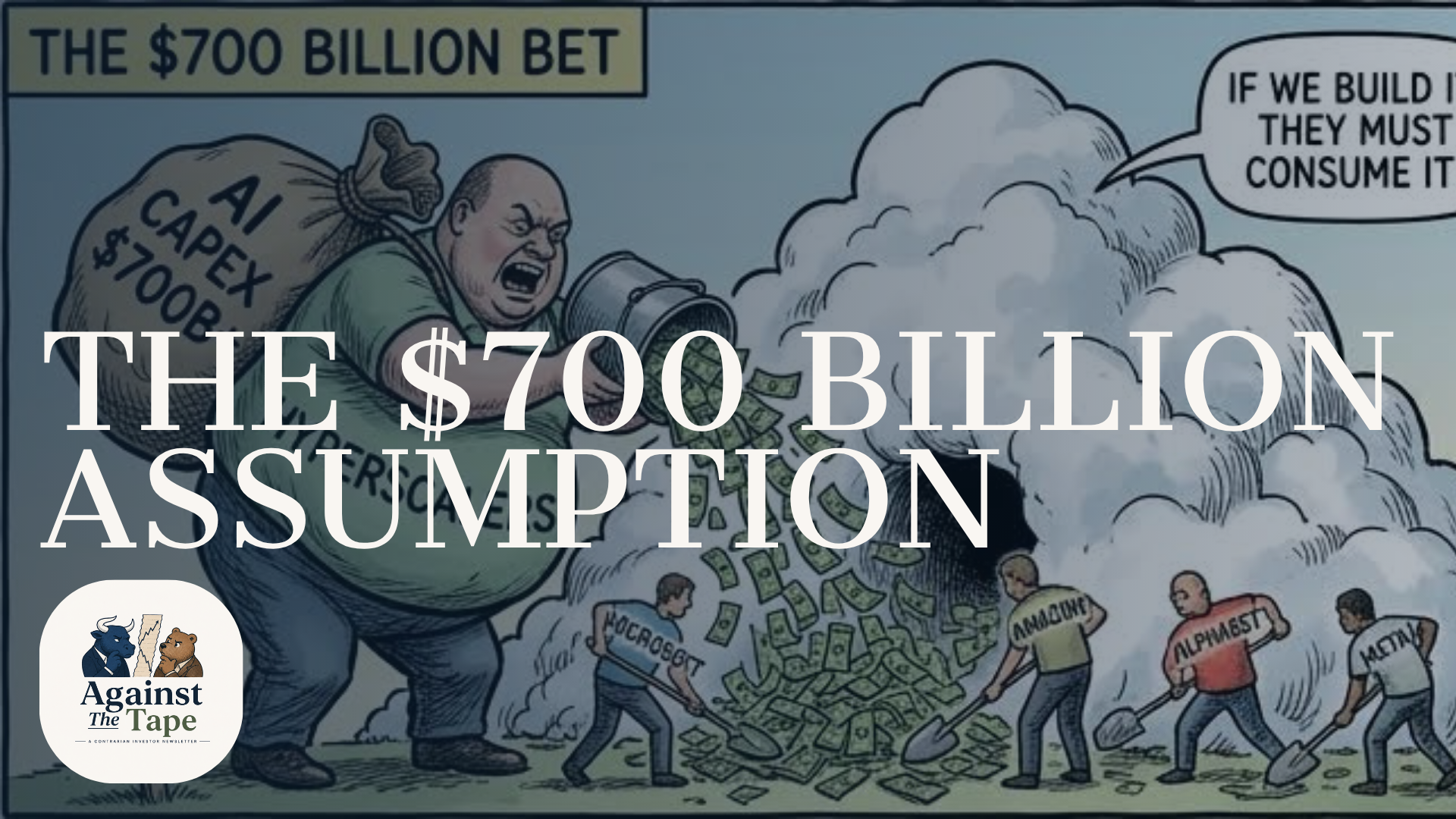
Last issue, we made the bull case. We believed every word. Here’s why we were wrong.
The AI trade is consensus long. Every major sell-side desk has upwardly revised hyperscaler price targets. NVIDIA has become the world’s most valuable company. The institutional position is clear: AI productivity is real, the cycle has years to run, and selling here means missing the decade’s defining trade.
Three Reasons The Other Side Has a Case
The ROI math at the hyperscaler level has never, once, closed. And $700 billion in annual capex is now riding on the assumption that it eventually will.
Nvidia’s valuation prices in a demand curve that doesn’t bend. DeepSeek already proved it can, and more efficient models are coming.
The electricity analogy everyone reaches for is right about the technology and wrong about who captures the value.
Your Tuesday morning starts the same way it has for eighteen months. Nvidia up. Microsoft reaffirming capex. A new model announcement from a lab you’ve never heard of, claiming to beat GPT-whatever on some benchmark. And today, like most days, the hyperscalers are all lifting in unison, same catalyst, same direction, every name on the same side of the trade.The AI trade has been the trade. Everyone's in it. Your allocation is in it. Your clients' allocations are in it.
And that's the problem.
When every institutional desk is positioned the same direction, when the trade has become so consensus that arguing against it feels like arguing against electricity, that's not a sign the trade has more room. That's the sign to stress-test it.
Last issue, we argued that AI is a productivity revolution in disguise, not a bubble. The bull case is real. The data points are real. The productivity literature is real. But "real technology" and "correctly priced technology" are not the same sentence. Cisco was real. The internet was real. Cisco still fell 86%.
The Lay of the Land
The bullish thesis rests on three pillars: the productivity data is coming in strong (nonfarm business productivity grew 3.0% in 2024, the best since the late 1990s); historical precedent says transformative technology always looks expensive early; and AI's compression of knowledge-work costs is a structural regime change, not a product cycle. Goldman Sachs revised its own skeptical note after finding that 25% of U.S. work tasks are exposed to AI augmentation. Microsoft , Alphabet Inc., Amazon , and Meta collectively spent north of $410 billion in AI-related capex in 2025, and are on pace to spend more than $700 billion in 2026. The hyperscalers are not blinking. The sell-side is not blinking. The narrative has the tailwind of a technology that genuinely works.
All of that is true.
The Turn
The ROI math has never closed, and right now, only the spenders are winning. The four hyperscalers will spend more than $700 billion on AI infrastructure in 2026 alone. OpenAI, the most prominent AI company in the world, generated approximately $4 billion in revenue in 2024 while losing an estimated $5 billion. Sequoia's "$600 billion question", how much AI revenue needs to exist to justify the infrastructure buildout, has not been answered. McKinsey's 2025 State of AI survey found that only 11% of enterprise AI pilots reach full-scale deployment. The licenses are being purchased. The workflows aren't being rebuilt. Look at where the stock returns have actually landed: the hyperscalers themselves, Nvidia, the data center REITs, the AI supply chain. The companies that are supposed to be the beneficiaries, law firms, regional banks, insurance companies, consulting firms, haven't seen it show up in margins. The productivity gain is real. But for this trade to hold at current valuations, the gains have to diffuse beyond the spenders. That hasn't happened yet, and the capex clock is running.
The investment ramp is a prisoner's dilemma, and that's how capex cycles end in writedowns. Microsoft cannot pause AI infrastructure spending while Google continues. Amazon cannot blink while Microsoft doubles down. Meta cannot let any of them pull ahead. Each player is rationally compelled to keep spending because the cost of falling behind feels higher than the cost of burning capital on infrastructure that hasn't produced returns. This is the structural mechanism that turns a technology cycle into a bubble: spending that accelerates without a feedback loop from ROI. Hyperscaler capex grew from roughly $230 billion in 2024 to $410 billion in 2025 to more than $700 billion in 2026, a ramp that has steepened even as enterprise deployment timelines have lengthened. No individual player has the incentive to blink first. The game theory is airtight. The arithmetic is not.
The semiconductor and AI supply chain has gone parabolic, and it's priced for a demand curve that model efficiency is already bending. Nvidia, TSMC, the broader AI infrastructure stack: these stocks have had runs that compress a decade of normal re-rating into eighteen months. The bull case requires that demand for compute scales with AI adoption indefinitely. In January 2026, DeepSeek released a model matching GPT-4-class performance at a reported training cost of $6 million. Better model orchestration, higher GPU utilization, and architectural improvements mean you can do more with the same hardware every six months. If inference efficiency continues improving at its current rate, the implied chip volumes these stocks are priced for are overstated. The supply chain got a massive re-rating on the assumption that more AI means linearly more chips. But smarter models and better orchestration mean the relationship between AI adoption and chip demand is not linear, and the market hasn't priced that yet.
Add the three together: the gains are concentrated where they shouldn't be, the spending is a structural ratchet that won't stop even without ROI, and the supply chain is priced for a demand curve that model efficiency is already disrupting.
The Talking Points
“The bull case on AI isn’t wrong about the technology. It’s wrong about who gets paid.”
“Cisco was the right call on the technology and still fell 86%. Being right about the revolution doesn’t make the entry point right.”
“$320 billion in annual capex chasing $4 billion in AI revenue isn’t a productivity story. It’s a faith-based investment. The faith might be correct. But faith-based investments have a consistent finishing time.”
The Trade
Going long Nvidia, long hyperscalers, long AI-adjacent data center REITs has worked. It’s crowded, priced for perfection, and leveraged to a ROI timeline that keeps getting pushed out. The people in those positions are smart. They’re also all in the same exit.
The more interesting setup is on the short side of AI-adjacent software with no pricing power: companies selling AI-wrapped SaaS at premium multiples into a market where open-source models will undercut them within 18 months. The second setup worth watching is in sectors that capture the productivity gain without paying the equity premium: healthcare systems, regional banks, and insurance companies that absorb AI efficiency at the application layer, improve their unit economics, and never show up in the hype narrative. They don’t get re-rated for the revolution because they’re not labeled AI stocks. The gap between what they’re worth and how they’re priced is where the actual trade lives.
Watch the hyperscaler capex guidance. The first major cut to AI infrastructure spending will tell you everything you need to know. Not because AI is over (it won’t be), but because the market is priced for capex to accelerate forever, and forever is not a financial model.
The Kicker
The bull case last issue was right about the technology. It was right about the productivity data. It may even be right about the long arc. But bubbles don’t require the underlying technology to be fake. They just require the price to be wrong.
The internet wasn’t fake. The stocks were wrong. Same story. Different decade.
Against The Tape is published every 2 weeks. An exercise in arguing the other side, not our base case. Not investment advice.

COMPANY
FOLLOW US
